A direct link is the path or URL that each user's computer uses to download a file or folder for the Power-user Library, from a shared drive, OneDrive, SharePoint, Dropbox, Google Drive or Box. Admins paste it in the File path field of a Library item in the Power-user admin portal. You need one to set up custom slides, templates, icons, pictures, charts or Tombstones.
In short
- Recommended: a shared drive or network folder, where you simply copy the full file path
- OneDrive and SharePoint: install the Power-user SharePoint Connector once, then paste the file link
- Dropbox, Google Drive, Box: transform the sharing link into a download link
- Icons and pictures: put the files in a .zip archive and link the archive
In this article
Which link to use for your storage
| Where the file is saved | What to paste in the File path field |
|---|---|
| Shared drive or local network | The full path to the file, for example \\server\Power-user\Templates.pptx |
| OneDrive or SharePoint | The file link copied from OneDrive, SharePoint or Teams (requires the SharePoint Connector) |
| Folder synced on each computer (Dropbox, Google Drive, Box…) | The local path, with an environment variable such as %USERNAME% |
| Dropbox, not synced | The sharing link with dl=0 replaced by dl=1 |
| Google Drive, not synced | https://drive.google.com/uc?export=download&id= followed by the file ID |
| Box, not synced | https://app.box.com/index.php?rm=box_download_shared_file&shared_name=… built from the shared link |
How to get the path of a file on a shared drive
A shared drive or local network is the solution we usually recommend: it makes the integration in the Library very easy.
- Save the file on the shared drive.
- Copy the full path to the file, including its name and extension.
- In the admin portal, paste it in the File path field of the Library item.
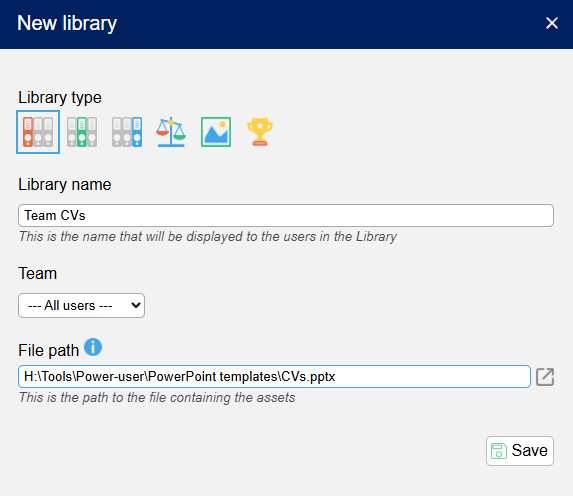
Custom slides Library item linked to a file on a network drive
How to get the link of a file on OneDrive or SharePoint

OneDrive and SharePoint logos
Before you start: ask your IT team to add the Power-user SharePoint Connector, following How to add the Power-user Connector for SharePoint. This is needed only once.
- Copy the link to the file:
- If the file is synced on your computer, right-click it, open the OneDrive options and click Copy Link.
- If it is not synced, copy the link from the browser or from Teams.
- In the admin portal, paste the link in the File path field.
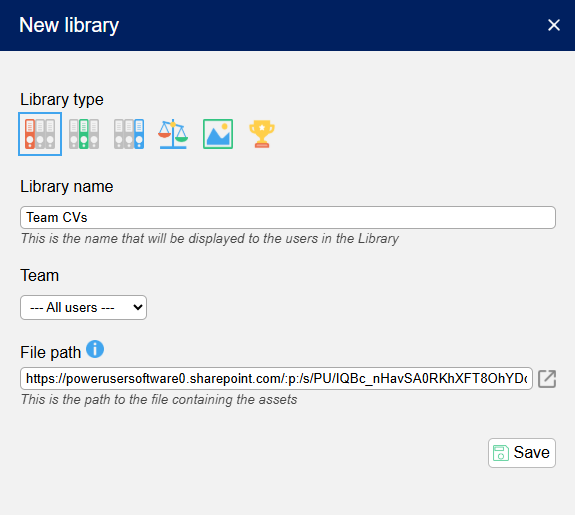
Custom slides Library item linked to a file on SharePoint
How to set a path for a folder synced on each computer
If your storage solution (Dropbox, Google Drive, Box…) syncs the folder on every user's computer, use the local path rather than a web link.
- Copy the full path to the file or folder, including the file name and extension.
- Replace the part that changes from one user to another with an environment variable, such as %USERNAME%, so that the path matches the local path on each computer.
- Paste it in the File path field.
Example: C:\Users\%USERNAME%\My-Storage_Solution\Power-user\PowerPoint templates\CVs.pptx
If the synced drive has the same letter on every computer, the full path is enough, for example G:\Shared drives\MyFolder\MyFile.pptx for Google Drive.
How to create a direct link from Dropbox, Google Drive or Box
When the files are not synced on the users' computers, the path is a web URL. A sharing link opens a preview page, so you need to transform it into a download link.
Dropbox

Dropbox logo
- Right-click the file in Dropbox and click Copy link or Share.
- You get a URL like https://www.dropbox.com/s/1di7uu4ydgpagrv/Presentation.pptx?dl=0
- Replace dl=0 with dl=1: https://www.dropbox.com/s/1di7uu4ydgpagrv/Presentation.pptx?dl=1
- Paste the transformed link in the File path field.
Google Drive

Google Drive logo
- Right-click the file in Google Drive and click Copy link or Share.
- You get a URL like https://docs.google.com/presentation/d/xa8frVaCo/edit?usp=sharing… The part after /d/ is the file ID.
- Build the download link with that ID and remove everything after it: https://drive.google.com/uc?export=download&id=xa8frVaCo
- Paste the transformed link in the File path field.
Box

Box logo
- Right-click the file in Box and click Share, then close the pop-up with the cross in its upper right corner.
- Click the name of the shared file. The address bar shows a URL like https://power-usersas.app.box.com/file/885413429030?s=xtfir6dmbclgj551km1zrics86jnhh3m: the first number is the file ID, the text after s= is the shared name.
- Put both in this URL: https://app.box.com/index.php?rm=box_download_shared_file&shared_name=xtfir6dmbclgj551km1zrics86jnhh3m&file_id=f_885413429030
- Paste the transformed link in the File path field.
Frequently asked questions about direct links
What is a direct link in Power-user?
A direct link is the path or URL from which each user's computer downloads a Library asset, such as a template, slides, icons or Tombstones. Power-user admins paste it in the File path field of a Library item in the admin portal.
Which storage does Power-user recommend for Library files?
Power-user recommends a shared drive or local network folder: you only need to copy the full path of the file. OneDrive, SharePoint, Dropbox, Google Drive and Box also work.
How do I link Power-user to a file on SharePoint or OneDrive?
Ask your IT team to add the Power-user SharePoint Connector once. Then copy the file link from OneDrive, SharePoint or Teams and paste it in the File path field of the Power-user admin portal.
How do I get a direct download link from Dropbox?
Copy the Dropbox sharing link and replace dl=0 with dl=1 at the end of the URL. The link then downloads the file instead of opening a preview, which is what Power-user needs.
How do I get a direct download link from Google Drive?
Copy the sharing link, take the file ID that follows /d/ in the URL, and build https://drive.google.com/uc?export=download&id= followed by that ID.
How do I add icons or pictures to the Power-user Library?
Put the .png, .jpg or .svg files into a .zip or another archive, store it in your shared location, and paste the link to the archive in the File path field of the Power-user admin portal.
Was this article helpful?
That’s Great!
Thank you for your feedback
Sorry! We couldn't be helpful
Thank you for your feedback
Feedback sent
We appreciate your effort and will try to fix the article