“The solution cannot be installed because it is signed by a publisher whom you have not yet chosen to trust” is an error that some computers display when installing Power-user in PowerPoint, Excel or Word. You can fix it in one of four ways: make Power-user a Trusted Publisher, make its installation folder a Trusted Location, remove the Trusted Publisher requirement, or configure inclusion list security.
- When: when installing Power-user, in the Microsoft Office Customization Installer.
- Fixes: Trusted Publisher, Trusted Location, Add-ins setting in the Trust Center, or inclusion list security.
- Default installation folder: C:\Users\%UserName%\AppData\Local\Power-user.
In this article
The certificate error message
The Microsoft Office Customization Installer shows: “There was an error during installation. The solution cannot be installed because it is signed by a publisher whom you have not yet chosen to trust. If you trust the publisher, add the certificate to the Trusted Publisher list.”
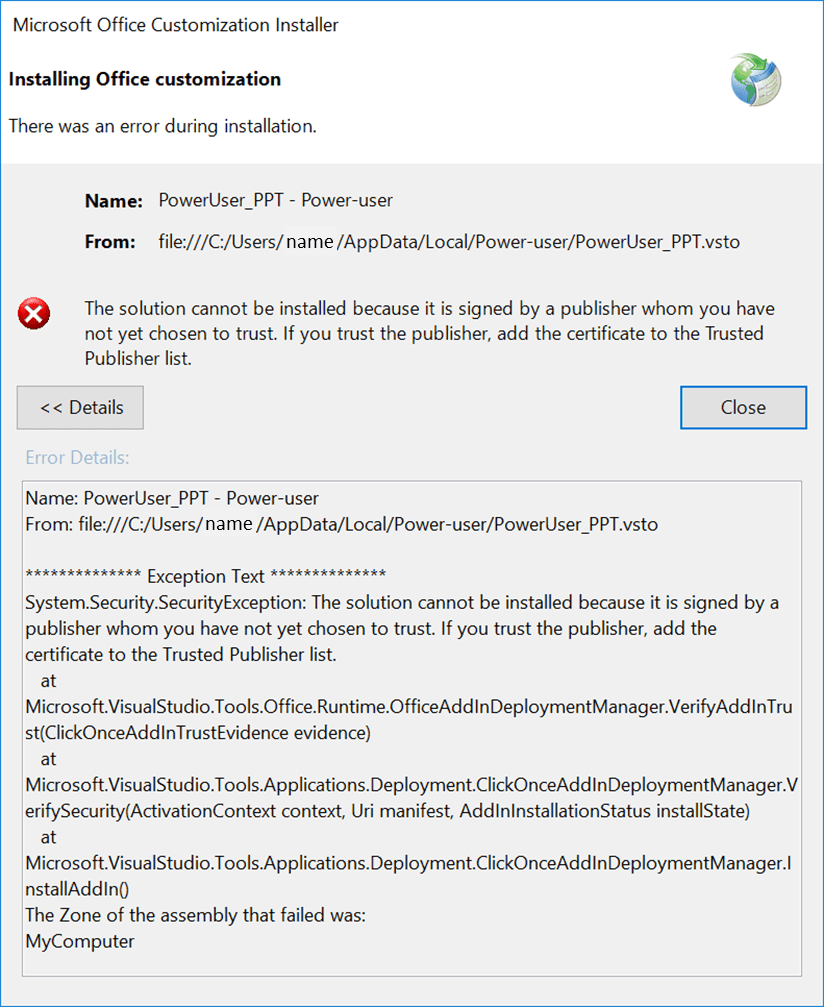
Microsoft Office Customization Installer error: the solution is signed by a publisher you have not yet chosen to trust
How to fix the certificate is not trusted error
Solution 1: Make Power-user a Trusted Publisher
- Right-click the Power-user.exe setup file.
- Click Properties.
- In the Digital Signatures tab, select Power-user SAS and click Details.
- Click Show certificate, then Install a certificate.
- Choose Current User and click Next.
- Choose Place all certificates in the same folder, then Browse.
- Choose Trusted Publishers and click OK.
- Click Next, then Finish.
Solution 2: Make the Power-user installation folder a Trusted Location
- In PowerPoint, Excel or Word, go to File, then Options.
- Select the Trust Center tab.
- Click Trust Center Settings.
- Select the Trusted Locations tab.
- Click Add a new location.
- Click Browse and select the Power-user installation folder, by default C:\Users\%UserName%\AppData\Local\Power-user.
Can't find the AppData folder? In Windows Explorer, click the View tab and check the box for Hidden items.
Solution 3: Remove the Trusted Publisher requirement for add-ins
- In PowerPoint, Excel or Word, go to File, then Options.
- Select the Trust Center tab.
- Click Trust Center Settings.
- Select the Add-ins tab.
- Uncheck Require Application Add-ins to be signed by Trusted Publisher.
Solution 4: Configure inclusion list security
Configure inclusion list security by following this procedure from the Microsoft website.
Frequently asked questions about the certificate is not trusted error
Why does Power-user say the certificate is not trusted?
Some computers block the Power-user installation because the add-in is signed by a publisher the user has not yet chosen to trust; adding Power-user SAS as a Trusted Publisher solves it.
How do I make Power-user a Trusted Publisher?
Right-click the Power-user.exe setup file, open Properties, Digital Signatures, select Power-user SAS, click Details, Show certificate, then install the certificate for the Current User in the Trusted Publishers store.
Where is Power-user installed by default?
Power-user is installed by default in C:\Users\%UserName%\AppData\Local\Power-user; this is the folder to add as a Trusted Location in PowerPoint, Excel or Word.
How do I add a Trusted Location in PowerPoint?
In PowerPoint, Excel or Word, go to File, Options, Trust Center, Trust Center Settings, Trusted Locations, add a new location and browse to the Power-user installation folder.
Can I stop Office from requiring signed add-ins?
Yes. In File, Options, Trust Center, Trust Center Settings, Add-ins, uncheck “Require Application Add-ins to be signed by Trusted Publisher” to let Power-user install.
What is inclusion list security?
Inclusion list security is a Microsoft setting for Office add-ins; configuring it with Microsoft's procedure is the fourth way to fix the Power-user certificate error.
Was this article helpful?
That’s Great!
Thank you for your feedback
Sorry! We couldn't be helpful
Thank you for your feedback
Feedback sent
We appreciate your effort and will try to fix the article