The Power-user Language feature is a feature of the Power-user add-in for PowerPoint that changes the proofing language of every object on every slide of a presentation, in one click. After translating a deck, you no longer have red underlines everywhere because the shapes still use the original language.
In short
- Where: Power-user tab › Text group › the flag button and its drop-down arrow
- What you get: the proofing (autocorrect) language applied to all objects on all slides at once
- Favorites: your own list of languages, with the first one applied directly from the ribbon
In this article
How to change the language of a whole PowerPoint presentation
- On the Power-user tab, in the Text group, click the arrow next to the flag icon to open the list of languages.
- Click the language to apply.
Power-user applies this proofing language to every object on all slides of the presentation.

Language menu of the Power-user tab with the list of favorite languages and My languages
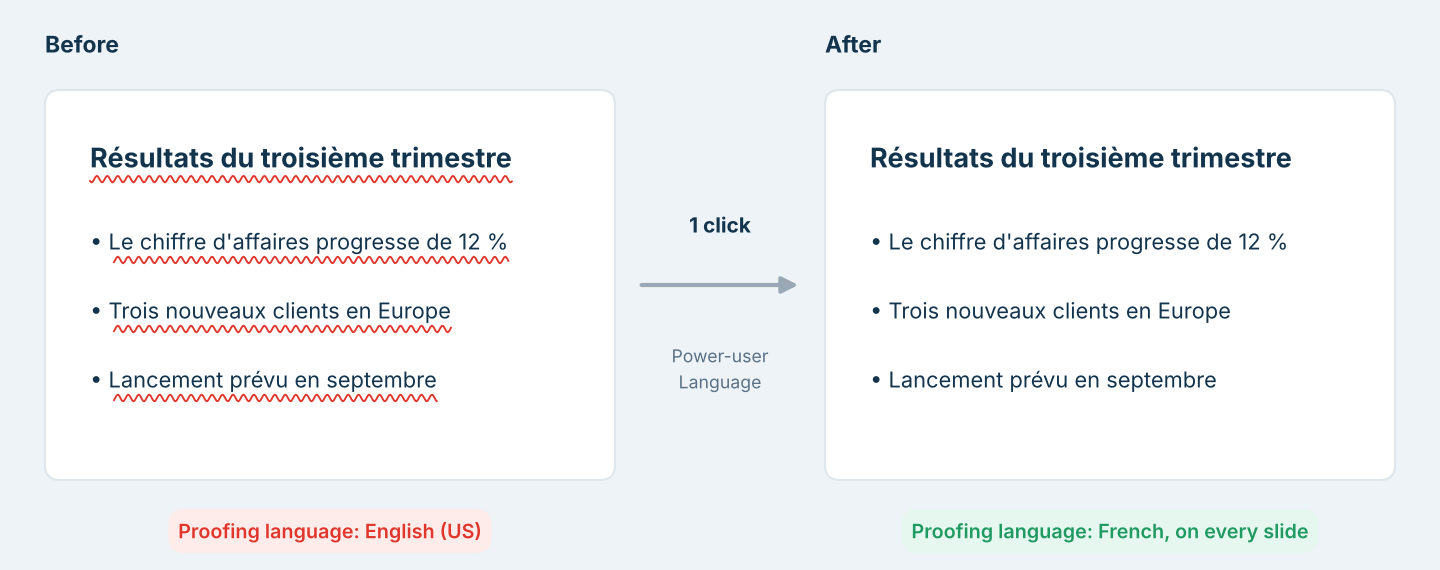
Before: French text underlined in red with English as proofing language. After: French applied to every slide in one click with Power-user
Why PowerPoint underlines all your text after a translation
In PowerPoint, you can change the proofing language from the status bar at the bottom of the window, but only for the selected shape.
When you translate a presentation, for example from English to French, every shape keeps English as its proofing language. All the French text is then underlined in red, as if it were full of spelling errors, and changing the language shape by shape is not realistic. Power-user changes it for the whole presentation at once.
Customize your list of languages
Keep your favorite languages one click away:
- Click the arrow next to the flag icon, then My languages.
- On the left, the list shows the languages of your menu. The language at the very top is also applied directly when you click the flag button on the ribbon.
- Select a language and click Up or Down to move it, or Remove to remove it from your favorites.
- Click a language on the right to add it to the list.

My languages window to choose and order your favorite proofing languages
Frequently asked questions about the PowerPoint proofing language
How do I change the language of an entire PowerPoint presentation?
With the Power-user add-in, click the arrow next to the flag icon in the Text group of the Power-user tab, then choose a language. It is applied to every object on all slides.
Why is all my text underlined in red in PowerPoint?
The shapes probably still use another proofing language, for example English on French text after a translation. PowerPoint changes the language only for the selected shape; Power-user changes it for the whole presentation in one click.
Can PowerPoint change the proofing language for all slides at once?
PowerPoint only changes the proofing language of the selected shape, from the status bar. The Power-user Language feature applies it to all objects on all slides.
How do I choose the languages shown in the Power-user Language menu?
Click the arrow next to the flag icon, then My languages. Add languages from the right, order them with Up and Down, and remove those you do not need. The first one is applied directly from the ribbon button.
Does changing the proofing language translate my PowerPoint text?
No. The proofing language only controls spelling and grammar checks. To translate text in PowerPoint, use the Power-user AI Assistant, then apply the new proofing language to the presentation.
Was this article helpful?
That’s Great!
Thank you for your feedback
Sorry! We couldn't be helpful
Thank you for your feedback
Feedback sent
We appreciate your effort and will try to fix the article